
Make social media work for your EU project
Motivated by recurrent challenges our members face, we have teamed up with MAIA EU project communications experts to deliver a deep-dive session on social media for research projects.
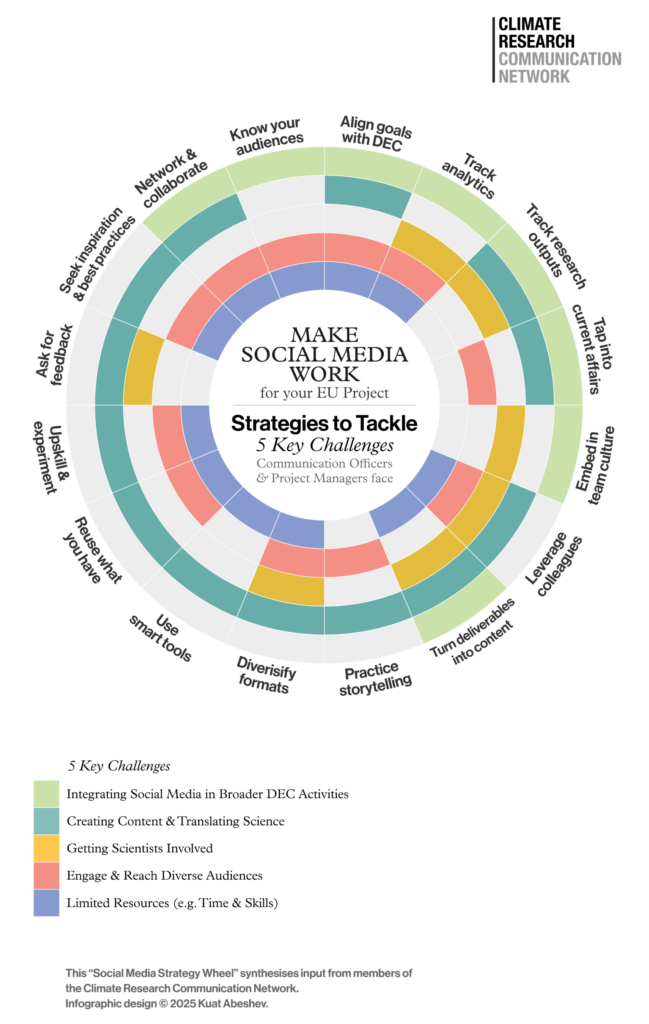
The content of this meeting has been summed up in a “Social Media Strategy Wheel” below: a practical resource designed to support communication officers, project managers and researchers involved in EU research projects.
A collective effort rooted in practice
The Strategy Wheel came out of a collaborative process, drawing on the collective experience of CRC-net members across European climate research projects and the expertise of communication experts from the MAIA EU project.
The wheel infographics was jointly developed by ClimTip and ESM2025, with ClimTip leading on the design. Most importantly, its content reflects the hands-on expertise of communication officers, project managers and stakeholder engagement leads who deal with the practical realities of EU-funded research communication every day.
Responding to structural challenges in EU project communication
EU research projects often face significant constraints when it comes to social media. Limited time and resources, short project lifecycles (~3-5 years), and the absence of easily “visual” outputs – like physical products or beautiful fieldwork photos – can make sustained social media engagement difficult. This is especially true for projects focused on climate model development. (Try live-tweeting a climate model calibration process – it’s not exactly Instagram gold.)
The Strategy Wheel responds to these realities by organising practical strategies around five recurring challenges commonly identified by project teams:
- integrating social media within broader dissemination, exploitation and communication (DEC) activities;
- translating complex scientific results into accessible content;
- involving scientists meaningfully in communication efforts;
- reaching and engaging diverse audiences;
- operating under limited time, skills and resources.
Rather than prescribing a single approach, the wheel offers a flexible structure that projects can adapt to their own objectives, audiences and capacities. Social media should support, not dominate, overall project communication strategies.
An open resource for the wider research community
The Social Media Strategy Wheel is shared as an open resource for anyone involved in EU research communication. While developed in the context of climate science projects, its principles and strategies work across research domains.
It may be particularly useful for:
- communication officers and project managers new to EU-funded projects;
- researchers who take on communication responsibilities within their projects;
- research project teams looking to structure or refine their social media presence;
- researchers and practitioners interested more broadly in research visibility and engagement through social media.